
Young adults in India are increasingly grappling with high blood pressure, a condition once thought to affect mainly the older demographics. Cardiologists point to sedentary lifestyles, obesity, chronic stress and unhealthy diets as primary drivers of this silent epidemic.

The number of individuals who declared a gross income of Rs 100 crore or more in their income-tax returns had risen to 301 in 2022-23, moderated slightly to 284 in 2023-24, then climbed to 415 in 2024-25.

'Food inflation is important and if that is controlled, then consumption will go up.'

'Improved law and order and transparent governance have helped change UP's investment image.'

In rural areas, the poverty ratio was estimated at 28.3 per cent whereas in urban areas it was 25.7 per cent, stated V Narayanswamy, Union Minister of State for Planning and Parliamentary Affairs in Rajya Sabha on Thursday, in response to a question by independent member Parimal Nathwani.

Lamborghini has sold 10,112 cars worldwide -- so India's 100 is certainly a big deal for them. But how big a deal is it for us to peg our consumption theories around, asks Rama Bijapurkar.

Internet subscribers, income growth, literacy and dependency ratio are the biggest drivers of growth.

Could the MPCE survey results be used as a basis of reconstructing the Consumer Price Index with new weights, asks Madan Sabnavis.

India's internet user base crossed 950 million in 2025, driven largely by rapid growth in rural connectivity, rising short-video consumption, and increasing adoption of AI, according to a report released by IAMAI on Thursday.

The next Census' findings will help identify the extent of India's ageing population and vulnerability levels.

If TVK MLAs and ministers are perceived as clean, or demonstrably cleaner than their predecessors, the credibility dividend will be enormous. The voter will feel rewarded, points out Ramesh Menon.

India's housing finance sector is riding a wave of post-pandemic revival, driven by policy support, digital innovation, and growing demand from younger homebuyers in emerging cities.

Packaged tea consumption in India has been under pressure due to inflation across the consumption basket coupled with higher tea prices. This is forcing tea drinkers to downtrade, especially in rural areas. Milk prices have also gone up and this has impacted tea consumption along with delayed winters in the north, companies have said. NIQ (formerly known as NielsenIQ) data shows that the packaged tea category grew around 4 per cent in value and volume terms in 2022 compared to 2021.

As the poverty rates in the country declined below 5 percent in 2024, a research study by State Bank of India also highlighted that the extreme poverty in the country has been reduced to minimal.

Hero MotoCorp, India's largest two-wheeler maker, has seen a decline in its market share in rural areas since 2018, losing ground to major competitors such as TVS Motor Company, Bajaj Auto, and Honda Motorcycle & Scooter India (HMSI), according to data from JATO Dynamics reviewed by Business Standard. Hero's share of rural two-wheeler sales in India has dropped from 40.4 per cent in 2018 to 33.3 per cent in 2023. In contrast, Bajaj's share increased from 12.7 per cent in 2018 to 13.9 per cent, HMSI's from 21.8 per cent to 22.2 per cent, and TVS' from 15.5 per cent to 17.8 per cent. Suzuki Motorcycle India has also seen its share rise from 1.7 per cent to 2.5 per cent.

While it is evident that the INDIA bloc has not shut its doors on Nitish Kumar, those within the NDA are hopeful that the JD-U's support base would benefit them as well

Inaugurating the Grameen Bharat Mahotsav, the Prime Minister exuded confidence that villages will play a key role in pushing forward the dream of Viksit Bharat by 2047.

HUL managing director Rohit Jawa's total remuneration in FY25 has witnessed an increase of 3.75 per cent to Rs 23.23 crore, according to the latest annual report of the FMCG major. Jawa's annual package included a salary of Rs 3.65 crore, allowances of Rs 11.45 crore, a bonus of Rs 3.78 crore and a perquisite long-term incentives of Rs 2.76 crore.

In May, Satpal Singh, who runs a dairy business with three buffaloes in Jewar, near Noida, was worried about the steep spike in input costs. Singh said dry fodder rates, which cost Rs 1,500-2000 per tractor trolley last year, were quoting at Rs 4,500-5,000. The price of other cattle feed ingredients (that include mustard meal and similar mixes) had also gone up from Rs 2,000 per quintal to Rs 3,100-3,200 per quintal.

"The report says that per capita consumption expenditure of 18.7 per cent of the rural population and 4.7 per cent of the urban population in the country is less than Rupees 12 per day. It implies that 16.3 crore people in the country spend less than Rs 12 per month representing 14.7 of the total population," Minister for Rural Development Reghuvansh Prasad informed the Lok Sabha on Monday.
The Indian economy may be registering strong growth, but nearly 20 per cent of the population or close to 250 million people of spent less than Rs 14 per person per day on consumption in 2004-05.
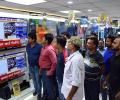
Nearly all FMCG companies like Marico, HUL, ITC and the rest have been indicating that the operating environment has been challenging, with drop in consumption, especially in rural areas, severe crunch in market liquidity conditions, and disruptions and floods in several parts of the country. To overcome this, they are boosting their direct reach in the countryside.

While companies have not launched too many products in rural areas of late, easy financing has helped push up demand.

India will be the world's third-largest economy by 2028 as it becomes the world's most sought-after consumer market and gains share in global output, driven by macro stability influenced policy and better infrastructure, Morgan Stanley said. From a $3.5 trillion economy in 2023, the Indian economy is projected to expand to $4.7 trillion in 2026, which will make it the fourth largest in the world behind the US, China and Germany.

Broadband connectivity to villages has been lagging, with delay in laying of an optical fibre network up to gram panchayats

'Three manufacturing sectors can create jobs by the million: Apparel, food, and electronic assembly.' 'Let's talk to them and ask them what it would take to scale by a factor of ten,' suggests Naushad Forbes.

'The intensity and frequency of heatwaves will be much higher than in previous years over Punjab, Haryana, Rajasthan, Gujarat, Madhya Pradesh and Odisha.'
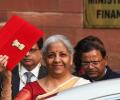
'... that it once again shies away from renewing its commitment to strategic divestment,' points out A K Bhattacharya.

Market experts say that of the total 600,000 villages in India, under two per cent or around 10,000 villages contribute to about half of the rural consumption in the country. Targeting these villages and ensuring that penetration is strong is key for most consumer goods companies.

As rural demand tapers, companies are back at the drawing board, firming up plans to beat the unexpected slowdown in sales.

Union Finance Minister Nirmala Sitharaman on Tuesday commended Indian financial sector regulators for doing a "world-class job" and bringing greater transparency into the system. Underlining that she is not against questioning or critiquing regulators, Sitharaman said there is a need to be "extremely conscious" about contributions made by them as well. Speaking at the Financial Express Best Banks Awards, the finance minister said, "I strongly recommend that facts are taken on board before we discuss anything to do with the regulators, strictly speaking."

Majority of 'Bimaru' states register faster fall in rural poverty, while pace mostly other way round for others

Consumption per capita was 5.6 times less in a month for the bottom ten per cent of the population than the top 10 per cent in rural areas during 2009-10.

Experts say the Bill should include higher-value food items than just cereals

The minister said the international experience suggests that the inequalities tend to increase in the early phase of development.

'it's not just youth in India who are left behind because of their inability to find jobs; nearly two-thirds of Indian women of working ages do not participate at all in the paid labour force.'

'80% of the rural and urban population don't have enough purchasing power.'

With a revival in demand and consumption, FMCG companies are looking forward to 2022 with positivity and hopes of sustaining a healthy growth trend across both rural and urban markets while gearing up to cater to the ever-increasing digitally active consumers and tackle the challenge of higher commodity prices. Health and wellness and convenience are going to remain key trends and FMCG companies are strengthening their core brands, driving premiumisation across their portfolios with targeted innovations as consumers are gravitating towards trusted brands looking for quality, purity and hygiene, in continuation of the trend that started since the pandemic last year. FMCG makers are accelerating digitalisation and are investing in building capability in e-commerce and Direct-to-Consumer channels, identifying it as a key vector of their growth as the threat of a possible third wave is still not away.

Moody's Ratings on Tuesday said India's growing water shortage can disrupt farm and industry sectors and is detrimental to the credit health of the sovereign as rising food inflation and decline in income may spark social unrest. It said decreases in water supply can disrupt agricultural production and industrial operations, resulting in inflation in food prices and hence can be detrimental to credit health of sectors that heavily consume water, such as coal power generators and steel-makers.

If you are bullish on the consumption theme, consider specialised mutual funds that focus on this theme. Remember that such sectoral mutual funds should not make up more than 5% to 10% of your equity portfolio.
